OUR STORY

Klein at the Vieux Remparts, since 1972

When visiting winemakers, it is really not uncommon to hear them claim that, in general, Belgians know wine well, sometimes even better than their own compatriots. It must be said that Belgium is not originally a wine-producing country, and that many Belgians were born with a cellar under...

When visiting winemakers, it is really not uncommon to hear them say that, in general, Belgians know wine well, sometimes better than their own compatriots. It must be said that Belgium is not originally a wine-producing country, and that many Belgians were born with a cellar under their feet, which their parents tended to fill with juice from all wine-producing regions of France and elsewhere.
Belgians are major importers and consumers, and we have developed a good wine culture built on discovery rather than on belonging to a particular terroir. The image of a good bottle of Bordeaux opened early in the afternoon and placed in its wicker or silver wire basket near the radiator for the evening guests, which will accompany duck breast/gratin dauphinois, is part of our collective unconscious.
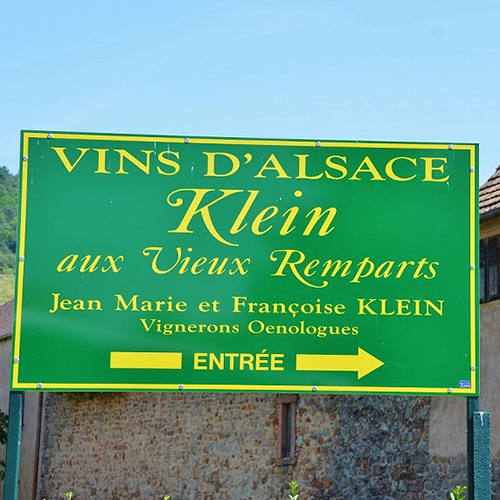
I see myself as a child waiting for hours while my parents finished tasting the wines in the cellar of Domaine Klein at Vieux Remparts in Saint-Hippolyte, only to see them come out all dazed and happy with the order they had just loaded into the trunk.
Maybe that's where I caught the virus without realizing it, in the smells of soaked wood, damp stones, and fermenting breaths.
But the story, it is going to change...
Read more

Alsatian Pinot Noir and “Connaître et Choisir LE VIN”, since 1995

Our desire to make wine is not new, nor is our interest in it as drinkers. Even though my very first date with Jade, one winter evening in 1996, was fuelled by Bison vodka at Bizon, fermented grape juice soon became a part of our lives...

Our desire to make wine is not new, and neither is the interest we have in it as drinkers. Even though my very first date with Jade, on a winter evening in 1996, was accompanied by Bison vodka at Bizon, our life quickly became quite infused with fermented grape juice.
Yet, nothing is simple for a young couple fond of wines.
Arriving in a Burgundian wine cellar, tasting with the little lady in a suit and buying a bottle, the cheapest one; drinking Grandgousier from Delhaize in 1-liter returnable bottles and sometimes, when the month hasn't been too tight, daring a Château Anthonic cru bourgeois. Going to a restaurant and getting poorly advised by a timid sommelier who tries to justify his suggestions by throwing out a few words of that obscure insider jargon he knows but which we understand very little anyway, to finally make our choice, as usual, on an Alsace pinot noir.
- ...a little bit cool?
- Okay, all right, a little bit cool.
- Who am I making you taste it for, sir?
- Ah yes, okay... (hmm, tastes) perfect, thank you.
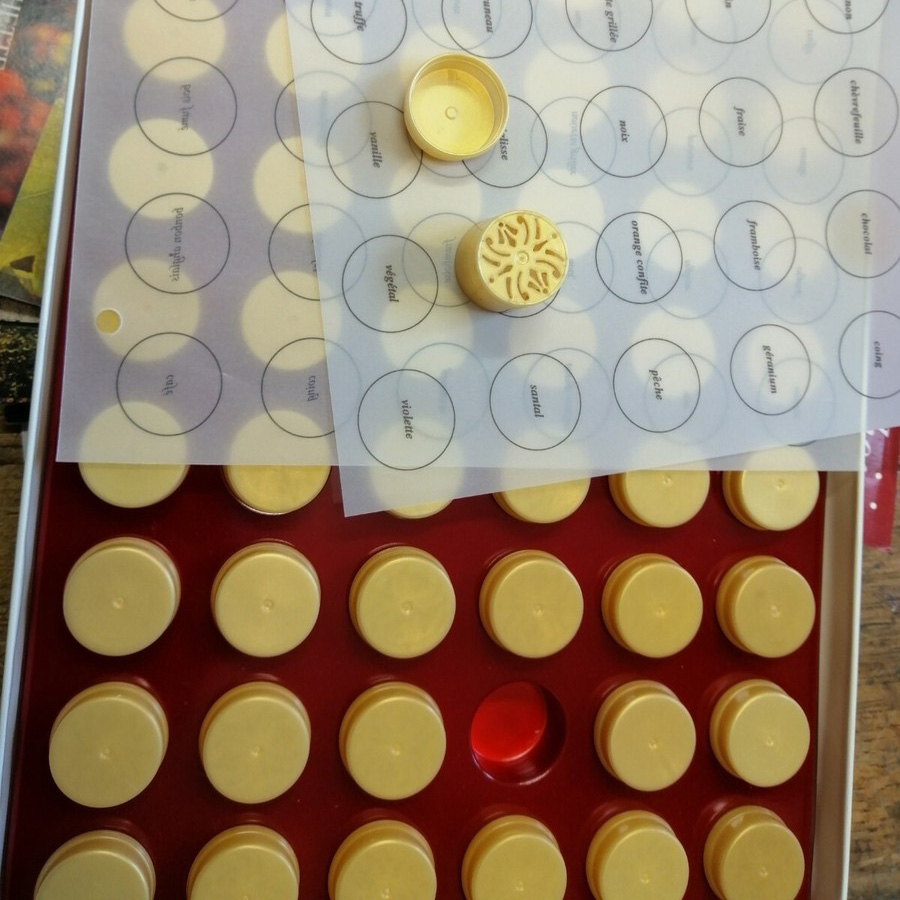
That did not stop us from trying to understand it more over time. By subscribing to "Connaitre et Choisir le VIN," a collection of booklets published by Hachette, and its box set with the 48 wine aromas in small beige plastic capsules, as well as the Hachette guide each year, by going through wine fairs at Cora or Carrefour, by making a memorable visit to a Champagne winemaker who would instill in me the theory of champagnisation and petnatization, by tasting improbable vintages with our old friend Olivier Paul, and of course doing a million other things.
Yet, throughout all these years, even though wine is a pleasure for us, I continue to experience that the discourse around 'Wine' is opaque, exclusive, that it often cultivates a form of insularity where the vocabulary serves as a passport, and that episodes around tasting can sometimes become borderline dramatic, even traumatic events.
What should I choose on this 40-page menu, what to say about this bottle without looking like an idiot, I'm at the bottom of the bottle and I realize it was corked, does it taste good or not, am I really the only one who likes it, I can feel that I'm missing something, oh gosh I didn't understand anything, etc...
Caught in the trap of conventional wine codes.
Until that blessed day in the spring of 2006 when we made the acquaintance of natural wine.
Read more
Trapped by the codes of conventional wine. Until that blessed day in the spring of 2006 when we made the acquaintance of natural wine.
Le Vinolubile, 2006: taking the drama out of wine

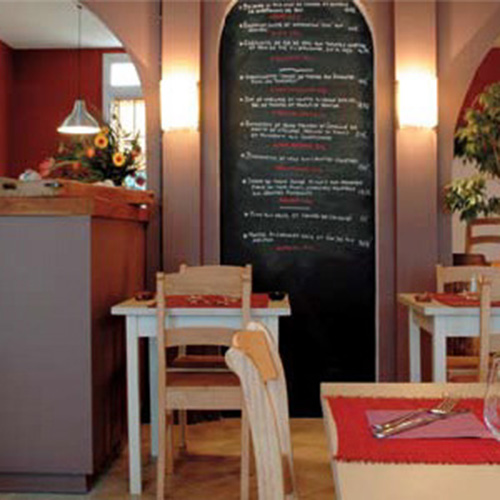
It's Marc Guillaume, a friend and merchant from Wavre, whom we run into one day on the pedestrian street at lunchtime and whose invitation we accept to join him in the new little restaurant of his two young friends, Romain Lecouvette and Matthieu Fontein. Romain welcomes us, he explains to us the ...;

It's Marc Guillaume, a friend and Wavre shopkeeper, whom we run into one day on the pedestrian street at lunchtime, and whose invitation we accept to join him in the new small restaurant of his two young friends, Romain Lecouvette and Matthieu Fontein. Romain welcomes us, he explains the concept; a short menu, nice products simply cooked by Matthieu, accompanied by natural wines. Never heard anyone say that a wine was natural or not.
And that is precisely the moment before the impact.
The one who will make us take the sweet and radical turn of our life, the very beginning of the winding path of wine we were about to embark on, there, without knowing it.
The pivotal moments are discreet; it is only years later that they can be identified.
To accompany the entrée of foie gras poached in a citrus broth, Romain suggests the Cour-Cheverny from Tessier, and he talks about it in such a simple and transparent way before serving it that I knew exactly what to expect when tasting it.
...2..1...impact.
The wine is bright, open, luminous, mouth-watering, and it fills us with joy.
It's obvious, I absolutely need to understand all of this, and no longer drink anything other than wines that are made like this.
A long series of meals at 'Vino' would follow. The restaurant was 22 meters as the crow flies from the house. It had become our canteen. Our own natural wine bistro closer to the living room than to our bedroom, almost.
In 2007 I started a HoReCa training at CERIA in Brussels, I will do my internship with them. And for the third of hours to be spent outside the kitchen, they suggested that I go for a tour in the vineyards during the harvest: Bojo at Guy Breton, Jura at Overnoy, etc...
Romain will tell me many things, including 2 that outweighed everything else: 'to learn about wine, you don't need school, go drink wine with friends' and 'the only question that matters is do I like it or not'.
Romain taught me that wine is just fermented grape juice, that it's simple, accessible, easy to make and to explain, and that anyone who claims otherwise does so to justify the price of their bottles. That natural wines are rarely below a certain price level, the price of craftsmanship, and possibly a fair wage, but rarely rise above another price level. It's consistent, easy to understand, fair.
He taught me exactly the opposite of what I had believed from the beginning.
Read more
“You don’t need school to learn about wine—go and drink wine with friends.”
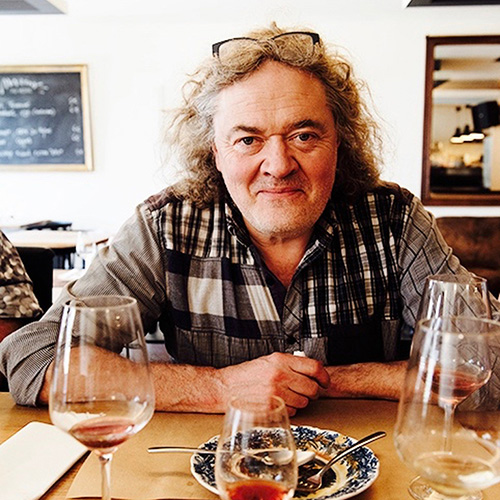
Laurent Mélotte: "Is it more or less different from the first one...?"

Laurent Mélotte was barely two meetings away from our very first nose in a glass of natural wine.
I had to find some reds from the Jura as part of this cooking course at CERIA that I attended from 2006 to 2009, and in particular from an oenology class we had in second year, with a very nice lady, who was substituting for the absent teacher and knew absolutely nothing about wine, therefore asking us to make presentations on...

Laurent Mélotte was barely two meetings away from our very first nose in a glass of natural wine.
I had to find some red wines from the Jura as part of this cooking training at CERIA that I took from 2006 to 2009, and particularly for an oenology class we had in the second year, with a very kind lady, certainly, who was substituting for the absent teacher, but who knew absolutely nothing about wine, and therefore asked us to make presentations in groups, by region, with, of course, the corresponding tastings, which in the end served as the lesson. My group had picked the Jura.
It was Romain who had advised me to go to Mélotte, a historic Belgian importer of natural wine, the only place around here where I would be able to find some without Gibolin©.
It was sometime during the winter of 2006/2007, the Odyssey of Flavors, at Laurent and Anne's, in their living room which served as their shop. I had asked him what Jura reds he had, and he brought out two bottles from Ganevat. I remember, at that time, I was only spending a few euros for a bottle, and I had been shocked by the exorbitant price of this Poulsard and this Trousseau, around 15€ if I remember correctly.
We are delighted today when we can get one for 4 or 5 times this price.
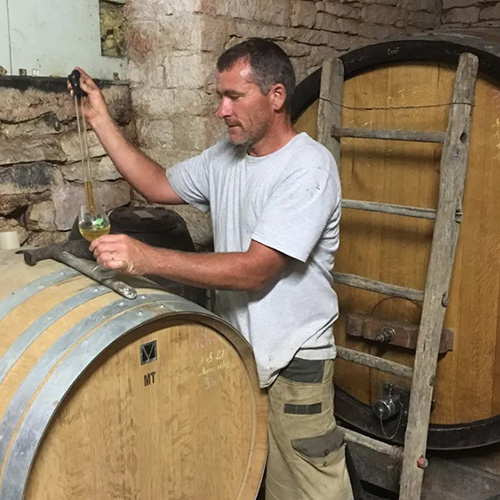
... There since the very beginning of the story, you know.
From that moment on, how to say the number of times this Incredible Peï, a trained brewing engineer, passionate about tea, a mycophile and so much more, crossed my path in terms of wine. It's amazing what I was able to learn with him in front of me, or with him beside me, his thematic workshops around wine, in his Guet à Pintes (the village café he had taken over to return the living room of the house to Anne and the children), at the winemakers', at winemakers' fairs, at 3 a.m. at the Descombes' without the Descombes, until the early morning at the Ganevats' with the Ganevats (...and also without them, by the way), endless discussions, sometimes stormy, always exhilarating, about the terroir, about grape varieties, about the (im)pertinence of planting in Belgium as well, about all kinds of winemaking, about the winemakers, about the relationships... In short, on absolutely all aspects of wine, and of grapes.
This journey without him would have been much less rich and certainly would not have gone through the same unlikely stages.
Read more

Jérôme Guichard: “Gueule à fioul, where did you park?”

Over the years, I ended up moving my hands away from the wax. Yet, I had rolled, dipped, molded candles and tapers under the expert eye of Pierre, my father. I gradually drifted away from the craft.

I met Jérôme at a winemakers' fair in Leynes on the border of Burgundy and Beaujolais. We quickly felt comfortable with each other, and little by little, he got me to do a few...

Over the years, I ended up moving my hands away from the wax. Yet, I had rolled, dipped, molded candles and tapers under the expert eye of Pierre, my father. I gradually drifted away from the craft.
I met Jérôme at a winemakers' fair in Leynes, on the border of Burgundy and Beaujolais. We quickly felt comfortable together, and little by little, he invited me to spend some time at his and Ghislaine's home, his wife, to watch him work, to give him a hand, and I understood what an artisanal wine was, a hand-crafted wine, from start to finish: working the plow with a winch to break up some of the grass, drawing off the juice with a hand pump, gluing the labels with milk, stamping the year and batch number on identical labels, waxing the necks...
He is within reach of thought at every moment, when I realize that our wines are made the way he makes his, by hand, that I have reconnected with craftsmanship. Jérôme, on the other hand, calls you an oilface if he sees you drinking something conventional, and he asks you 'where are you parked' while looking for your glass to pour in from the bottle that, one would say, is always stuck in his hand.
Jérôme conveyed to me his desire to teach. With him, I understood that for every question asked, there are always at least two possible answers that usually oppose each other.
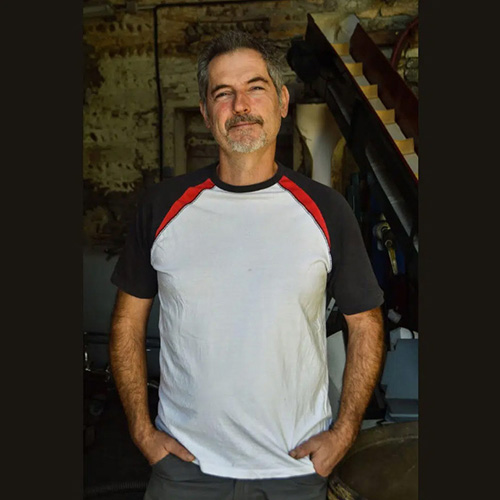
Jérôme convinced me to start by planting and to think afterwards.
Read more

Lilian Bauchet: “No, actually, I don’t care”

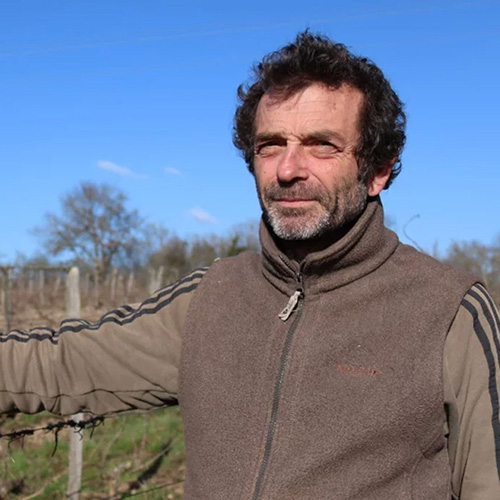
He is the man who brought the bug into our lives—and the first person from whom I heard the word “hybrids”. We had known each other since 2015, when we sold wine in our candle shop, including his Beaujolais cuvées: L’Herbe Folle, Sur la Root, Da Zi Bao, Barrique White and Gun’s and Rosé...

He is the man who brought the bug into our lives—and the first person from whom I heard the word “hybrids”. We had known each other since 2015, when we sold wine in our candle shop, including his Beaujolais cuvées: L’Herbe Folle, Sur la Root, Da Zi Bao, Barrique White and Gun’s and Rosé. A former IT specialist, he left everything behind in the Paris region and moved his wife and children to Beaujolais. He wanted to make wine. At first, organic wine, natural wine and hybrids were not even part of the plan. That was the path he found along the way.
Summer 2016, he wants to meet winemakers who work with interspecific varieties, and decides to come take a tour in Belgium, this other wine country.
So here we are setting off on an excursion to Servaas in Kortrijk, to Philippe Grafé in Emines, or to Baulers at the Domaine du Chapitre, to taste, to understand. His decision had already been made before this trip; sooner or later he would get rid of his gamay to replace them with hybrids.
Spring 2017, I am at his place at the moment he receives his first grafts of Souvignier gris and Muscaris. I already had in mind the deep desire to plant vines in Wavre, and I still saw myself well putting Gamay and Pinot Noir. Trying to produce small, enjoyable, and supple wines as these grape varieties allow.
And there appeared the very first real discussions with this guy who was about to plant these 2 hybrids completely illegally (authorized 10 days after his planting, 10 days during which he felt like a pirate in a sea of Gamay), with his main question: what interest did I see in the idea of planting varieties that would have to be assisted from the start and forever.
Bad calculation when he placed his order, he will end up forcing me into the trunk with the 150 excess feet of Gris Souvignier, telling me, 'You'll find a place to plant them.'
They were going to find a place to stay the very next day in the gardens of some members of the future association who would accept, foot by foot, my proposal to use their gardens without permission, a telephone operation that I had launched during the 6-hour journey back: 50 at Nathalie's, 40 at Patrice's, 25 at the training vegetable garden of Froidmont, etc...
This is the beginning of the mosaic plot.
Lilian finally set up an association (as they say over there) VBL, vitis batardus liberata, since 2022, which he considers to be the worthy successor of a union founded in the 1940s by André Fauvel and his hybridophile friends, the Fenavino (National Federation of the New Vine), which published 231 issues of a journal dedicated to hybrid grape varieties "La Viticulture Nouvelle," and which disappeared in the 1960s under the pressure of campaigns denigrating these grape varieties.
The last issue ended with these words:
In this season, the leaves detach from the branches, twirl in the winter wind to give themselves one last illusion of movement and life, and then they fall… and they die!… Thus disappears our bulletin. But the tree remains! Winters are not eternal, sunny springs follow the sad days of cold and storms. As an English poet said, the sun never stops shining behind the thickest clouds! The death of those who leave does not stop the life of those who remain! We, you, and then others after us and you, will continue our struggle
I like to believe that we, hybridophiles from everywhere, are the ones who continue.
Today Lilian cultivates only hybrids, both wine grapes and table grapes, he continues his Benedictine work of gathering and digitizing all existing information about resistant grape varieties, he likes to promote his wines and, in general and about many things, he actually doesn't care.
Read more
Éric Dubois

Éric Dubois, "the more one knows, the less one knows"

At his death, in 1929, Clos Cristal had been bequeathed to the hospices of Saumur by its creator, Antoine Cristal, who, to take up the profession of winemaker, had sold his business in textiles. A small business that would later become La Redoute — incredible, this story…

At his death, in 1929, Clos Cristal had been bequeathed to the hospices of Saumur by its creator, Antoine Cristal, who, to take up the profession of winemaker, had sold his business in textiles. A small business that would later become La Redoute — incredible, this story…
He was the one who had notably come up with the idea of these walls built in the vineyard, which allowed him to reach high levels of ripeness at a time when there was quite a bit of chaptalization in the region.
Well, the Clos was managed by Éric Dubois for about twenty years, up until the 2015 vintage. Éric then worked for a few years at La Coulée de Serrant, before taking over, in 2018, the Domaine de la Franchaie in Savennières, where he now makes, with Alex, his wife, wonderful wines that are perfectly natural.
We sold the wines from Clos Cristal around 2015, at our place, in the store. We had gone to see him with Jade and we found Éric's wines reflected his image: composed, calm, elegant, and above all generous.
There too, it is a friendship that was built over the course of reciprocal travels.
At Éric's, seeing him work in the cellar was totally inspiring. In the vat room, we are subjected to stress and, very often, with fatigue setting in, we overflow like milk on the stove. It's at that moment that I bring out my mental image of Éric working: his work overalls, his boots, the right word, the precise action. And it works every time: the pressure eases.
He was undoubtedly the first who, despite my meager volumes, my lack of knowledge, and my hesitations, took me seriously. I realized in his eyes that I was indeed making wine.
As a beginner winemaker, we all have a master teacher, whether as part of a final professional training internship or simply as a self-taught person: a winemaker whom we can almost call at any time to express a doubt, submit a choice or idea, or get their opinion on an action in the cellar or in the vineyard.
He has been and remains this mentor, to the point that, when I am in the car for a while and I am going to take the opportunity to make a few phone calls, I often hesitate between him and my mother.
Read more
Loading...