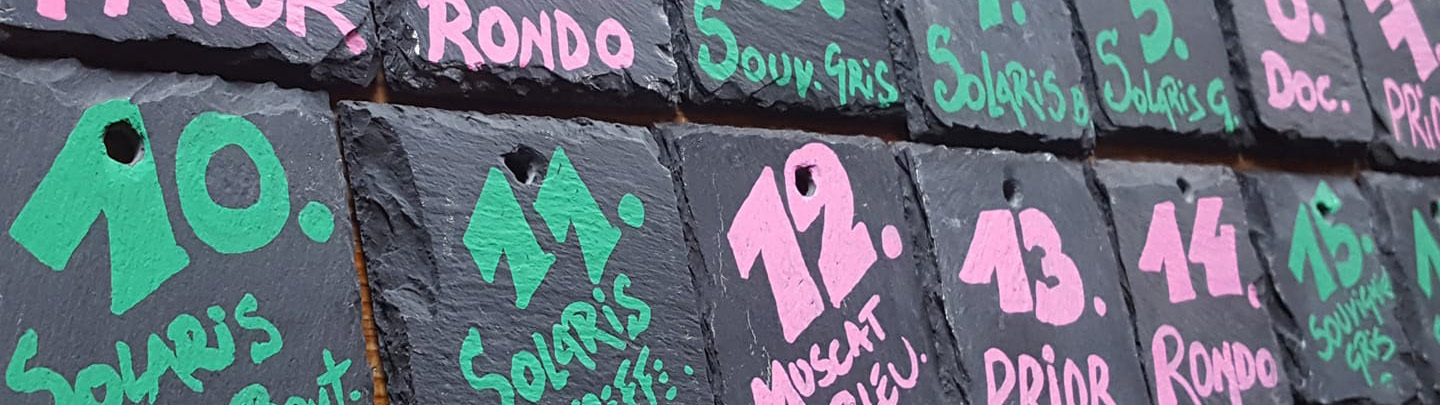
HYBRID GRAPES
Phylloxera arrived in Europe around 1870 in the soil of pots containing so-called 'American' grape varieties.
To respond to the major crisis that this devastating aphid was causing to the French vineyard, two lines of work were undertaken.
The horizontal axis
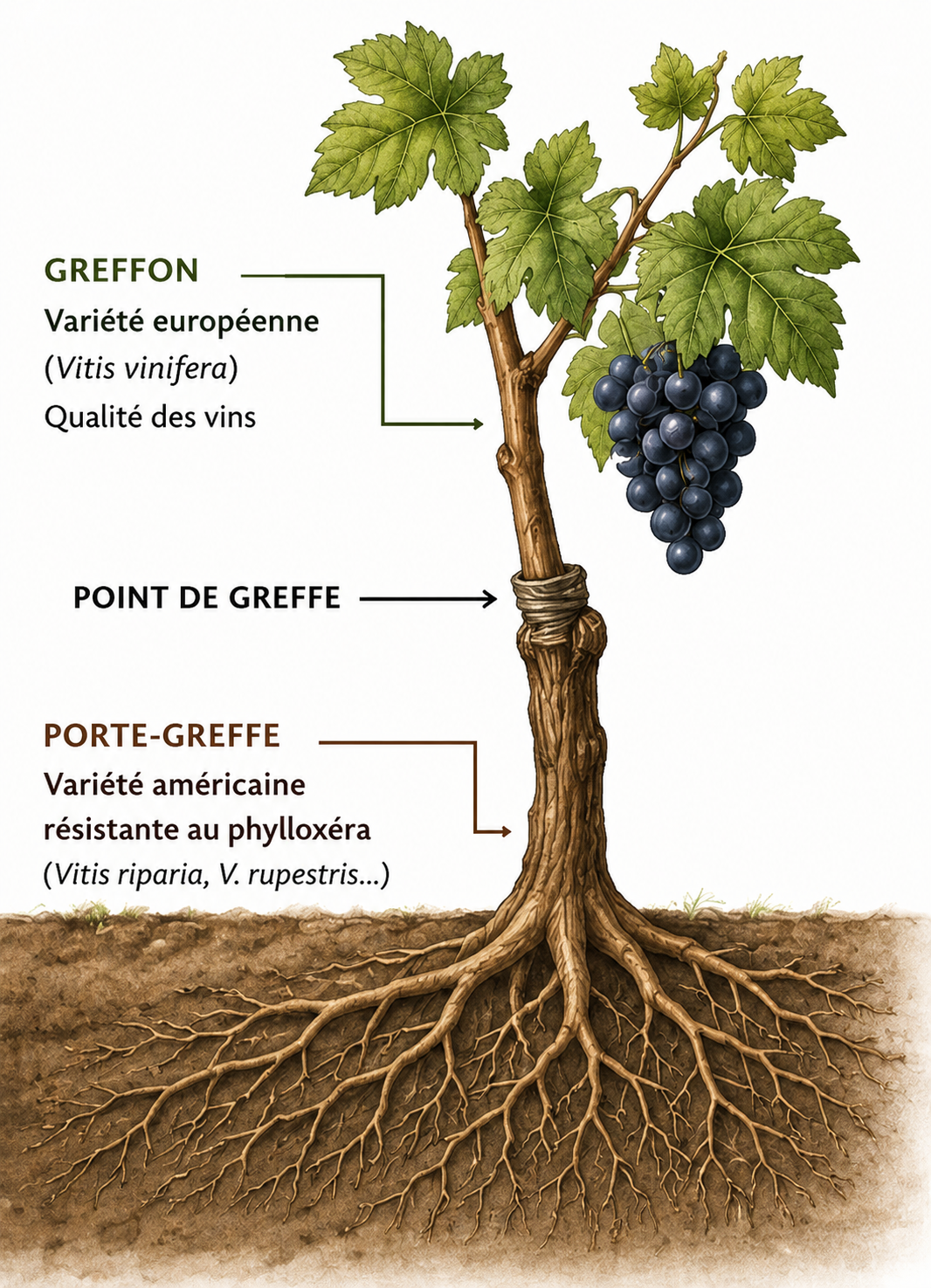
To graft the European varieties on aphid-resistant roots.
The method is quick: in a few years, the vineyard is back on its feet.
But the aerial part is sensitive to the other two scourges brought in with the American plants: downy mildew and powdery mildew.
The pesticide industry will overflow with ingenuity to offer solutions that will quickly lead to the vineyard's total dependence on their products.
The vertical axis
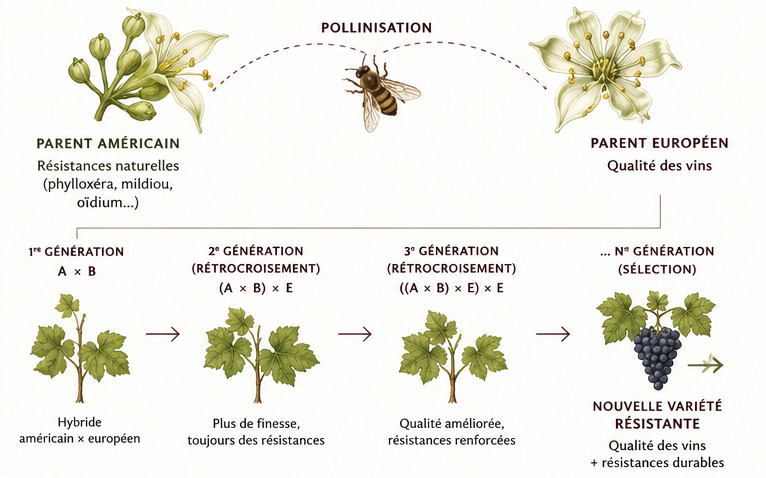
To hybridize, to obtain a new variety by pollination of two plants — American + European, then American-European + European, and so on.
The goal is to mix genetic heritages and to incorporate genes for resistance to phylloxera, but also to other fungal diseases.
The method is slow: it takes several years to go from the seed of a new variety to the bottle, and several decades to multiply the backcrosses.
But it allows for obtaining varieties better adapted to these new pathogens, capable of producing, with no or much fewer treatments, wines with organoleptic quality comparable to their ancestors vitis vinifera.
We believe that the lobbies of the pesticide industry played, out of financial interest, a role in the denigration and uprooting campaign of these new plants, which made up nearly 30% of French vineyards until the 1960s.
We are convinced that hybrids, like vinifera, selected in accordance with a terroir and a climate, and vinified by talented artisans, express just as much the soil, the climate, the work, and the sensitivity of the winemaker.
From an organoleptic standpoint, it is true that these hybrids can present, for those discovering them, a new taste and tactile reference point.
They are often more rustic in their aromatics and affect the palate differently. One might find them lacking in finesse at first, and nothing replaces a Gamay — although Chambourcin may come close…
But it is simply a matter of experience. By returning to them repeatedly, as we did with red wines when we only drank white, with our first ten orange wines that all seemed to taste the same, or with sous-voile wines that initially all seemed to taste of walnuts, we learn to understand them.
The palate becomes more discerning. Hybrids eventually match a desire, a moment, a pairing.
After this stage of discovery, it can become obsessive. We soon find ourselves regretting having opened anything other than a hybrid wine because we are actually getting a little bored with a bottle of vitis vinifera.
And then comes the final stage, as happened to many people discovering natural wines: you only want to drink hybrids, and you clear out your entire cellar.
On the other hand, from a growing perspective, by planting these interspecific vines — and vinifying them without inputs — we immediately move towards a form of viticulture in which the winegrower is no longer a manager of vine diseases and a corrector of juice in the cellar, but a guide to the plant's growth and an observer of fermentations.
It is important to realise that obtaining a harvest from vinifera is a battle that starts in April and ends when the grapes are finally in the vat. That includes biodynamics. Treat, fight, get up before sunrise, choose the right window, spray, dust, prepare, refill, gear up, with a big tractor full of horsepower...
Today, in a world that is falling apart, starting a wine activity with these living grape varieties does not seem completely absurd to me.
Leave what already exists in place, of course. But above all, let us continue planting varieties that are not dependent on crop-protection products and that are willing to grow without human intervention!
And above all, wine is about stories, adventures, excitement and emotions. Removing everything related to treatments from the equation allows all of that to happen...